EZwald: electrostatics of charged bilayers with defects
Emilia Szynwald, Undergraduate, Computer Science
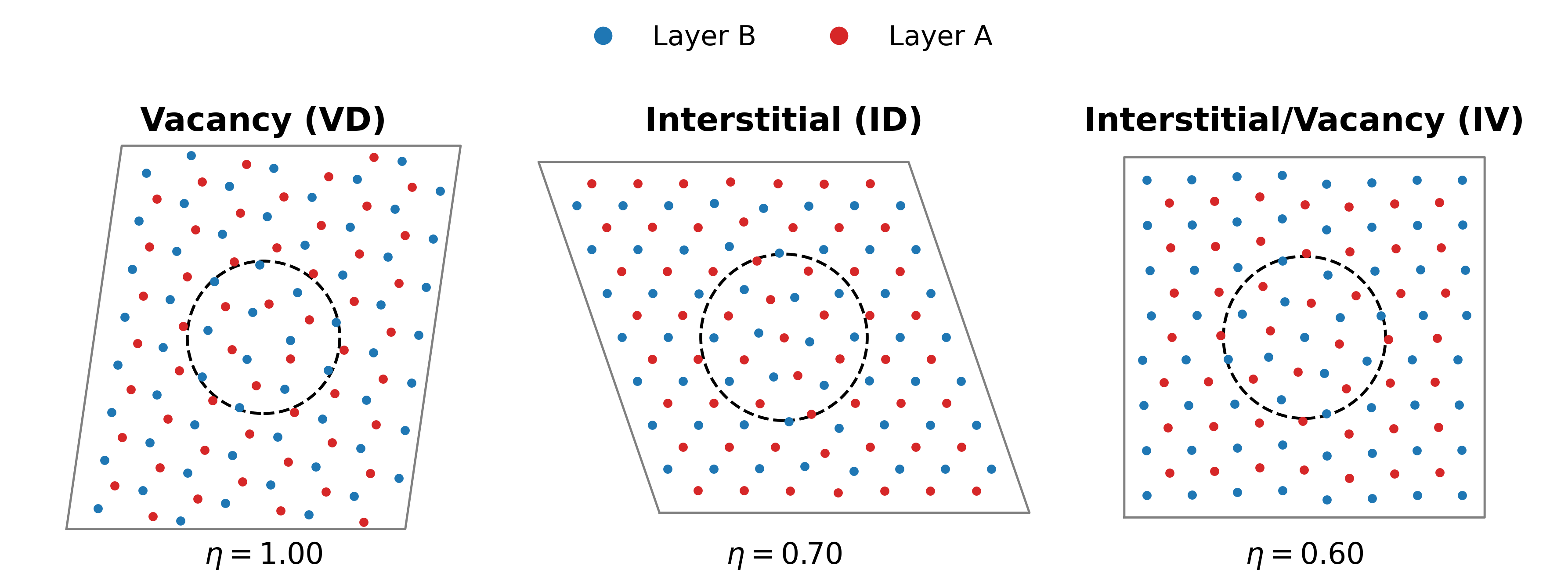
Emilia lead the development of EZwald, an easy-to-use Python implementation of Ewald summation for quasi-two-dimensional charged systems. Built on JAX, it runs on GPUs and optimizes both the particle positions and the shape of the simulation cell. It handles different charges across the layers and point defects such as vacancies and interstitials. As the two layers are pulled apart, the optimization automatically discovers the stable crystal phases and the transition phases between them. The code is modular, so it can be imported as the potential energy calculator in a larger molecular dynamics or Monte Carlo program, or extended with more features to model new experiments.